

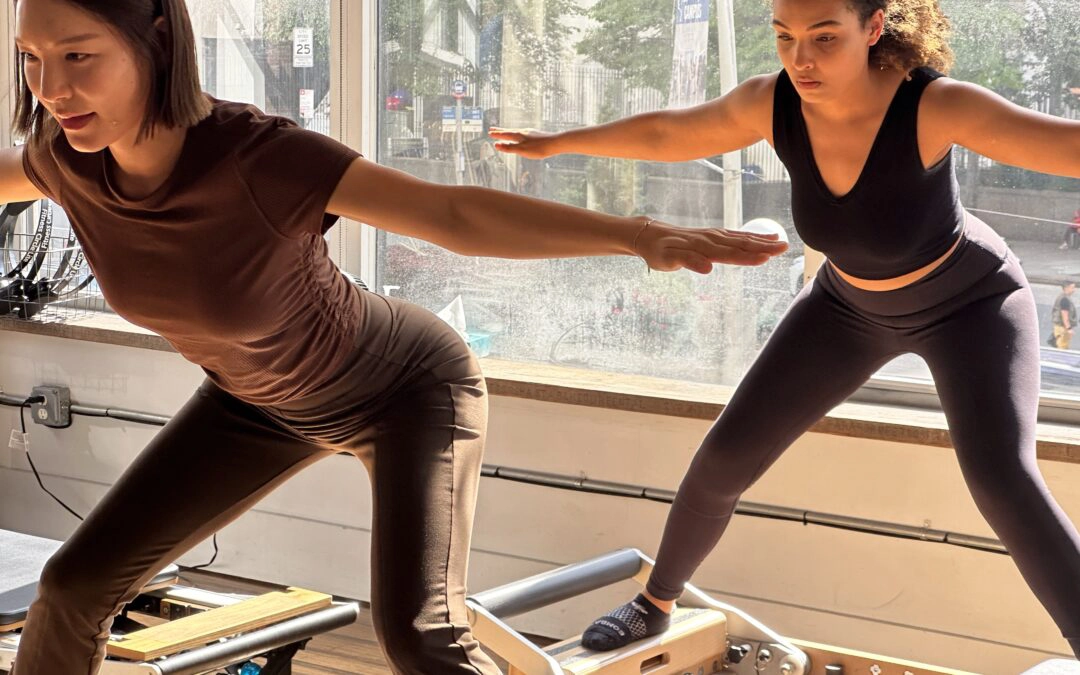
Many people start Pilates because they want their bodies to feel stronger and move better, but they’re also hoping to see a visible change in how their body looks. Pilates can absolutely influence body shape — but not because it “lengthens muscles” or burns large amounts of calories. The transformation comes from alignment, deep muscle activation, posture, and consistent practice.
Pilates reshapes the body by improving how your muscles support your skeleton and how efficiently you move. These internal changes translate into external results that look natural and sustainable.
How Posture Changes Your Appearance
One of the earliest and most noticeable benefits of Pilates is improved posture. When the muscles that support your spine, ribcage, and pelvis begin to work in better coordination, your torso lifts, your shoulders open, and your alignment becomes more balanced.
A six-month trial found that Pilates training significantly improved postural alignment, including measurable changes in shoulder and pelvic positioning (Rodrigues et al., Journal of Bodywork & Movement Therapies, 2013).
Rodrigues et al., 2013
Better posture alone can make you appear taller, narrower through the waist, and more evenly proportioned.
Why the Waist Looks Tighter With Pilates
Pilates targets the deep abdominal muscles that act as stabilizers rather than just the surface-level abdominals. The transversus abdominis, in particular, wraps around the torso like a natural corset.
Ultrasound imaging has demonstrated that classic Pilates exercises increase activation and thickness of the transversus abdominis and internal obliques (Critchley & Pierson, Manual Therapy, 2008).
Critchley & Pierson, 2008
When these muscles engage more effectively, the waist appears more supported and controlled — not because fat is removed, but because the midsection is structurally held in a more efficient, lifted position.
How Stronger Glutes Change Hip and Leg Shape
Many people overuse their hip flexors and quads while underusing their glutes. Pilates reverses this by strengthening hip extension, lateral hip stability, and the deep muscles that control pelvic alignment.
Research on Pilates-based programs has shown improvements in lower-body strength, pelvic stability, and balance, particularly in the muscles involved in supporting the hips (Plachy et al., Journal of Strength and Conditioning Research, 2010).
Plachy et al., 2010
Visually, this leads to a more lifted seat, more symmetrical hips, and better leg alignment.
The Kind of Muscle Pilates Builds
Pilates doesn’t aim to increase muscle size the way heavy resistance training does, but it does improve muscular endurance and coordination. Controlled repetitions and sustained tension build lean tissue that looks firm and balanced.
In a 12-week mat Pilates program, participants showed significant improvements in abdominal endurance, upper-body endurance, flexibility, and posture (Plachy et al., Journal of Strength and Conditioning Research, 2010).
Plachy et al., 2010
This type of muscular development changes the outline of the body without adding bulk.
How Pilates Supports Weight Loss Without Competing With Cardio
Pilates is not designed as a high-intensity fat-burning workout, but it supports weight-loss efforts in several meaningful ways:
- It reduces stiffness and pain, making you more active throughout the day.
- It improves movement mechanics, helping you perform other forms of exercise more effectively.
- It reduces stress and improves emotional regulation. Chronic stress has been associated with increased abdominal fat and altered cortisol responses (Epel et al., Proceedings of the National Academy of Sciences, 2000).
Epel et al., 2000
Because of this, people who pair Pilates with moderate walking or cardio and balanced nutrition tend to see better body-composition changes than with intense programs alone.
How Long It Takes to See Visible Changes
Visible changes from Pilates come gradually and build on each other.
After 3–4 weeks:
Movement feels smoother, posture improves, and muscles begin activating more evenly.
After 6–8 weeks:
The waist appears more controlled, the torso more lifted, and the hips more supported.
After 12 weeks or more:
Postural improvements become more stable, and the silhouette changes enough that clothing fits differently. Studies on mat Pilates over three months or more show consistent improvements in posture, flexibility, and endurance.
Plachy et al., 2010
What Pilates Cannot Do
Pilates cannot lengthen muscles (their attachment points don’t change), spot-reduce fat, or replace heavy resistance training for maximising muscle mass.
But it can reorganise movement patterns, improve deep muscular support, and create a more aligned and balanced body — changes that are visible and long-lasting.
The Bottom Line
Pilates changes body shape by improving posture, strengthening deep stabilising muscles, supporting the hips and glutes, and creating lean muscular endurance. These internal changes translate into an external shape that looks more lifted, balanced, and defined.
It’s not a quick transformation, but it is a reliable and sustainable one.
Sign up now to start your transformation.