
8 exercises to improve balance using the mat and the Wunda chair
Principle: Concentration
Balance is not fixed. It teeters and adjusts; it goes off-kilter and then rebounds… just like our body in motion. The ability to recover after being imbalanced is the secret. I observe that many feel failure when they fall out of a good habit, miss a meditation, or wobble in a balance exercise. This is the work; the wobble is the evidence of balance.
Our body, mind, and spirit crave balance. There is a lot of overlap here, but just think about your work/life balance, your diet, self-care, social activities, ability to rest, play, and work toward achievements and life goals. Time management is a major obstacle for so many people, and when we get that in line, balancing the weight of the world makes a whole lot more sense.
In Pilates, we talk about balance in a physical sense, but as we know, the positive ripple effect of our work is one of its greatest side effects. Balance in the physical will bring you balance in the metaphorical.
I believe that being strong in the body = strong in the mind = better choices all around. It’s one of the only things we have control over, and that control can lead to freedom in all areas of our life.
So here I will share just a few exercises that help your actual balance.
Balance, as it relates to movement and stability in the body, is a combination of 4 things: 1. Alignment, 2. Strength, 3. Proprioception, and 4. Energy. If you understand where you are in space, aka your alignment, and have strength in your muscles to maintain it, you must add a layer of focus with your eyes and your energy, and then it all comes together.
The first group of exercises 1, 2, & 3 can be done on a mat or at home. Side-lying hip work helps to create balance in the hip structure. You would want to include hip extension and adductor work as well to have fully balanced, strengthened hip muscles. I chose these because the glute medius is the focus, and it’s often a weak area in our bodies. Strength and awareness in this muscle helps us to stand up on one leg, recover from unstable surfaces, and helps to keep the pelvis level.
Exercises 4 & 5 can be done standing on a flat surface, step, or yoga block. Choose the flat surface with your eyes closed to work your intrinsic foot muscles without proprioception. Focus on grounding your foot and feeling the work op the back of the standing leg.
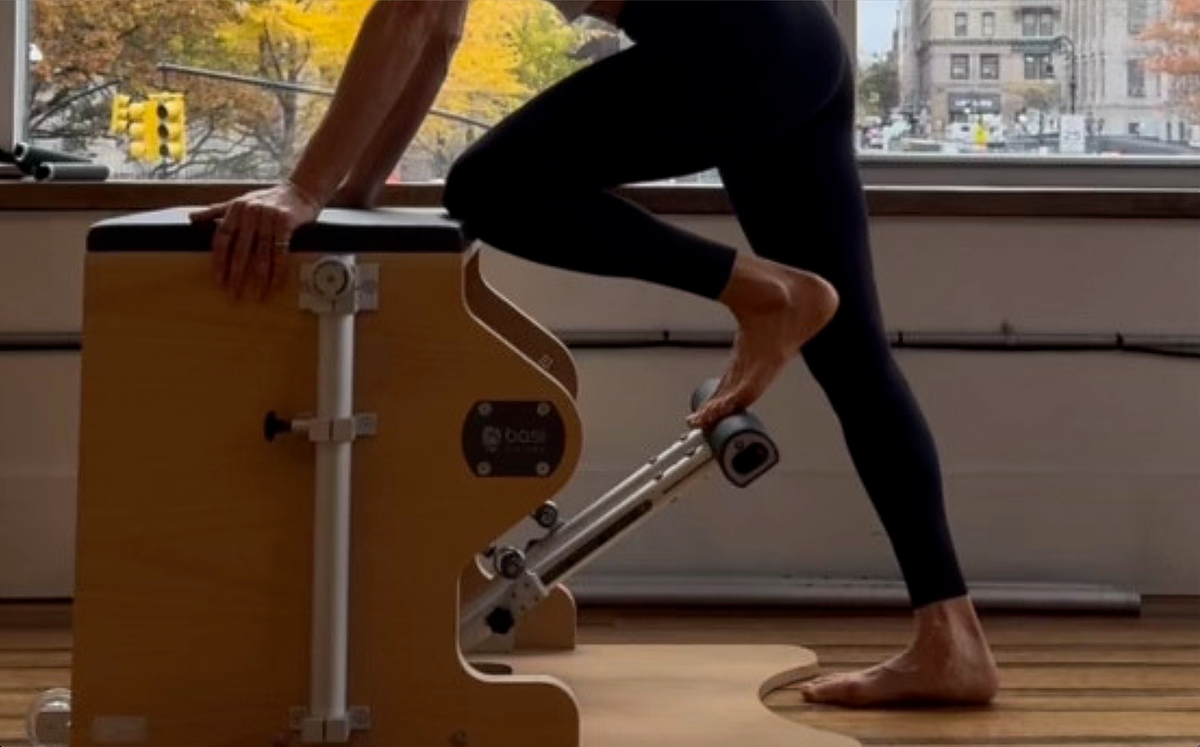
The second group of exercises demonstrated is on the Wunda Chair.
Exercise 1 is called the standing leg press. Focus on pulling up on the standing leg, feeling your foot grounding and keeping the pelvis level as the moving leg presses up and down. In the BASI Pilates Teacher Training, we teach this with a straight leg at the top of the movement for full knee extension and isolated hamstring and hip extensor work at the bottom. It can be done closer to the chair for a simpler focus on the standing leg. Exercise 2 is a variation in releve or heel lift. You can try this parallel or turn out.
The following exercises require a box as a stable surface for the standing leg, and the foot that is on the chair pedal acts as an unstable surface
Exercise 3 use a tail wag or lateral flexion of the pelvis on the trunk. Exercise 4 is a standing leg press tracking the knee over the foot. Exercise 5 is a standing leg press plus a leg pump, keeping the torso vertical and feeling deep flexion of both ankle joints.
Remember the best way to get good at balancing is to balance. Try holding your kitchen countertop and standing on one leg. Remember, the foot is the point of contact, but you need to involve the whole body. And don’t fall.
From BASI Pilates Comprehensive Teacher Training Course:
Gluteals Side-Lying Series:
1. Side leg lift
2. Forward and lift
3. Forward with drops
Standing Balance on Block
4. Balance with leg reach
5. Balance with hip flexion
6. Balance with hip extension
From BASI Pilates Comprehensive Teacher Training Course
1. Leg Press Standing
From BASI Pilates Legacy Program
2. With releve
3. Balance side plie
4. With leg press
FOLLOW US
For full length videos that benefit our scholarship program visit Virtualogic.earth